
Every waterproof jacket brief starts with a number: 5,000 mm, 10,000 mm, 20,000 mm. That number describes the fabric. Yet when waterproof garments fail in the field, they overwhelmingly fail at the seams. Understanding why — and how testing catches it — saves you from approving a sample that cannot survive its first season.
The millimetre rating on a waterproof shell describes the fabric. Most field failures happen at the seams. Test both, specify both, and require written ISO 811 records per batch instead of a mill certificate from last year.
What the Millimetre Number Means: ISO 811
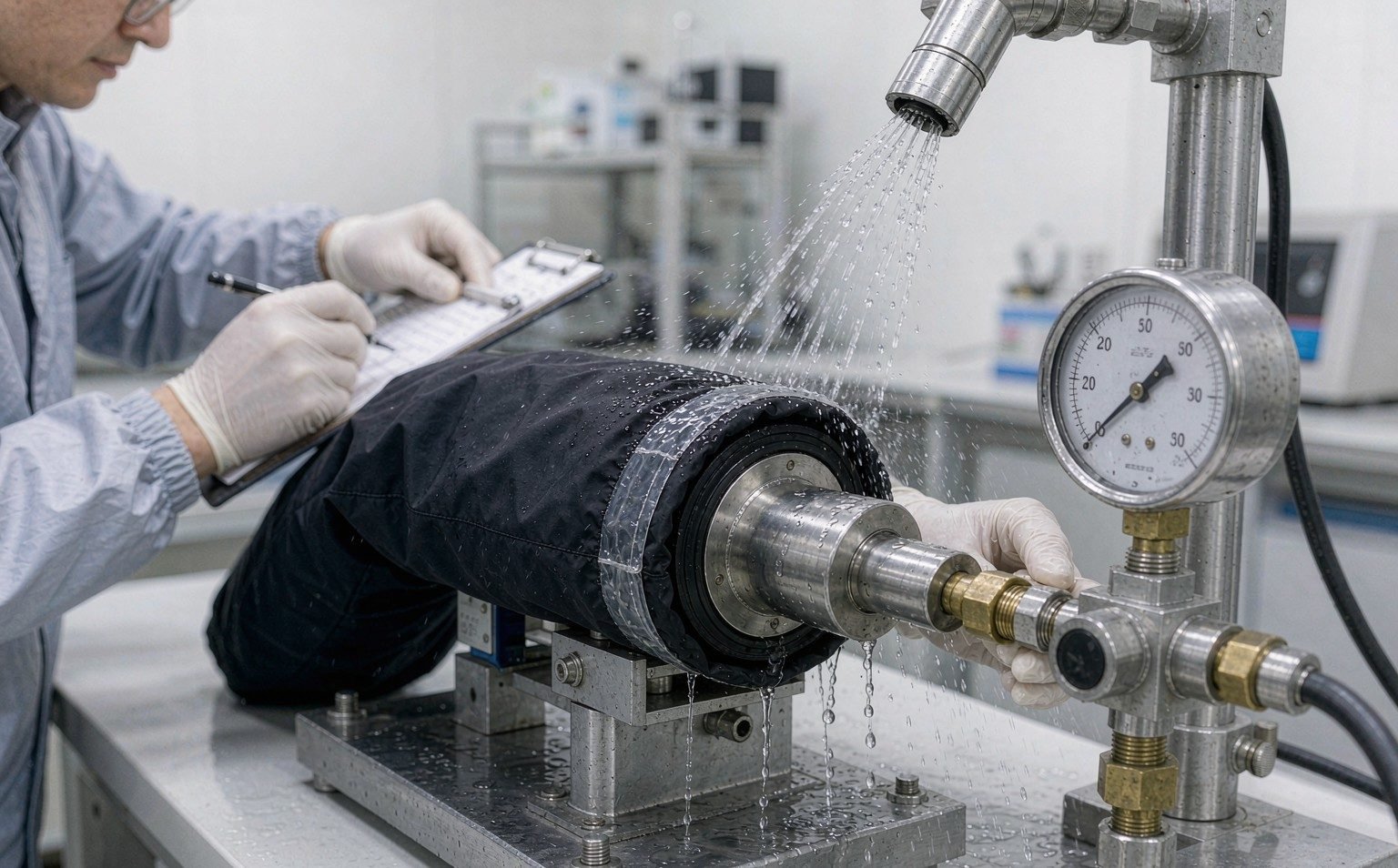
The hydrostatic head test (ISO 811, equivalent to AATCC 127) clamps a fabric sample and raises water pressure beneath it until three drops penetrate. The height of the water column at that point, in millimetres, is the waterproof rating.
| Rating | Withstands | Typical use |
|---|---|---|
| 0–5,000 mm | Light rain, dry snow | Urban jackets, water-resistant shells |
| 5,000–10,000 mm | Moderate rain, average snow | General ski wear, work rainwear |
| 10,000–20,000 mm | Heavy rain, wet snow, some pressure | Performance ski and outdoor shells |
| 20,000 mm+ | High-pressure, prolonged exposure | Technical mountaineering, professional foul-weather gear |
Pressure matters beyond rainfall: kneeling on wet ground, a backpack strap, or sitting on a ski lift presses water against the fabric with far more force than falling rain. This is why seat and knee panels benefit from higher ratings than the headline number.
Why Seams Are the Weak Point
Sewing a seam punches hundreds of needle holes through the membrane or coating. Each hole is a capillary path for water. A jacket in 10,000 mm fabric with untaped seams will leak at the first sustained shower — through the stitching, not the fabric.
Seam tape solves this by heat-bonding a waterproof film over the needle holes. The critical decisions:
- Fully taped vs. critically taped. Fully taped seals every seam in the garment. Critically taped seals only exposed seams — shoulders, hood, chest — and is a legitimate cost-saving for some uses, but it must be specified knowingly, not discovered later.
- Tape width and adhesion. Tape must cover the seam allowance with margin; narrow or poorly bonded tape lifts at the edges after washing.
- Crossing points. Where seams intersect, tape layers stack up. These junctions are the highest-stress points and the first place adhesion fails.
- Temperature window. Tape bonds within a narrow temperature and pressure range. Too cold and it peels; too hot and it damages the membrane. This is process control, not materials — which is why it belongs in factory QC, not just the spec sheet.
What EN 343 Adds: Testing the Garment, Not the Swatch
Fabric-level ISO 811 numbers come from the mill's lab on flat swatches. EN 343 tests the finished garment — fabric and seams together — in a rain tower, and rates both waterproofness and breathability in classes up to 4. A garment certified EN 343 class 4-4 has demonstrated, as a sewn product, that it keeps water out.
For programmes without formal EN 343 certification, the factory-level equivalent is in-line seam testing: sample garments from each production lot are checked for seam leakage before packing. We run this alongside our standard AQL 2.5 final inspection on waterproof styles.
Ask one question that settles it. When a supplier quotes a waterproof rating, ask: "Is that the fabric rating, or the garment test?" The answer tells you immediately whether seams are in scope.
The Test Reports Worth Requesting
- ISO 811 / AATCC 127 report for the exact fabric lot — not a generic datasheet from the fabric catalogue.
- EN 343 certificate if your market requires certified rain protection, referencing your garment style.
- Seam leakage records from in-line production testing for your order.
- Wash-durability data if the garment relies on a DWR finish — how the rating holds after the wash cycles your users will actually put it through.
Specifying It Properly in Your Tech Pack
A waterproof specification that survives production states four things: the fabric hydrostatic head with test method (e.g. 10,000 mm, ISO 811), the breathability target with method, the seam treatment (fully taped, and tape width where it matters), and the test the finished garment must pass. Leave any of these out and the factory will fill the gap with its default — which may not be yours.
If you are comparing constructions, our 3L vs 2L guide covers how the laminate structure itself affects both durability and waterproofing. Or send us your target conditions — climate, activity, price band — and we will recommend the construction that fits, with counter-samples in 7–10 days.
Why garments leak when the fabric passes
A shell can carry a 20,000 mm fabric and still leak through its seams. The explanation is almost always in the taping process rather than in the membrane.
Every needle hole from sewing is a potential water path, which is why seam sealing exists and why a taped seam is a process output rather than a material property. Three variables govern whether a tape actually bonds:
- Temperature. Too low and the adhesive never flows into the fabric. Too high and it degrades or strikes through to the face.
- Pressure. Insufficient pressure leaves channels along the tape edge. It looks bonded and leaks under load.
- Speed. The tape needs dwell time at temperature. Running the machine faster raises output and quietly lowers bond quality.
These three are set per fabric and re-checked whenever the fabric lot changes, which is where inconsistent programs come from: the settings were validated on the sample fabric and never revisited for production. Two more failure points follow later. Tape can lift after repeated washing if the adhesive was not matched to the coating, and narrow tape applied over a bulky seam crossing will bridge and eventually peel. Both show up as customer complaints months after the goods shipped, long after the file is closed.
This is why we keep writtenISO 811 records per batch rather than relying on a single annual fabric test, and why a garment-level EN 343 test is worth the small additional cost on any PPE program.
Frequently asked questions
What hydrostatic head rating do I actually need?
Match it to the exposure. Around 5,000 mm handles light rain and short exposure. 10,000 to 15,000 mm suits sustained rain for general outdoor use. 20,000 mm and above is for prolonged pressure, such as kneeling on wet ground or carrying a loaded pack.
Does the waterproof rating drop over time?
Yes. Abrasion, washing, and contamination from body oils and detergent residues all reduce the effective rating. The DWR finish degrades first, and once the face fabric wets out the garment feels wet even though the membrane would still pass a laboratory test.
What is the difference between fabric testing and garment testing?
ISO 811 tests the fabric under a column of water. EN 343 tests the finished garment including seams and closures, which is where real-world leakage occurs. Both have a place, and a fabric-only report says nothing about your seam construction.
How do I verify a supplier's waterproofing claim?
Ask for ISO 811 test reports tied to the production batch rather than an annual mill certificate. Confirm the report relates to fabric you are actually buying, and where the garment is used as PPE, ask for the EN 343 garment test as well.